
Support for Integration of Work and Childcare
At the High Energy Accelerator Research Organization (KEK) , we offer a variety of support programs to help our employees balance work and childcare, including childcare leave, parental leave (paternity leave), partial leave for childcare, early and late shift, a flextime system, a telework system, leave system for childbirth or childcare, and support for using babysitters.
KEK encourages all employees to make active use of these systems as diverse work options so that “work” can be integrated with “marriage, childbirth, and childcare,” in accordance with their personal lifestyles and career aspirations.
At KEK, Childcare Leave uptake rate for fiscal year 2025 was
100% for women and 85.7% for men.
*Support systems available may be different depending on employment type, etc. (please check KEK’s work rules, labor-management agreement, etc.).
Support System for Integration of Work and Childcare
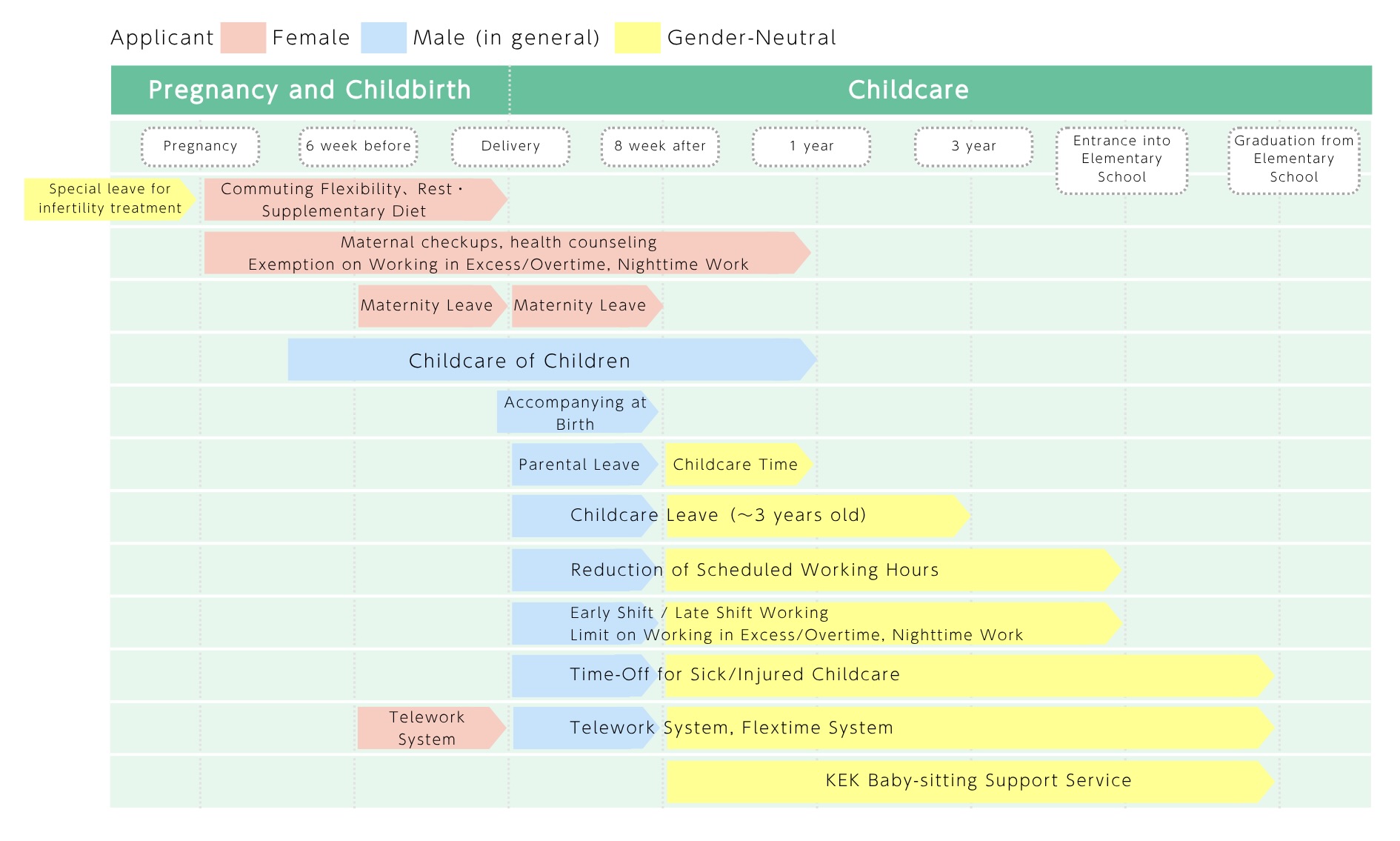
Leave Programs
| Programs | Summary | Salary |
| Maternity Leave | Female employees are entitled to take leave for a period of their choice within the 6 weeks prior to childbirth and for 8 weeks following childbirth. (Restrictions on work) | Paid |
| Childcare Leave Parental Leave (Paternity Leave) | Employees may have childcare leave for the period for which you apply, up to the day before your child’s 3rd birthday. When combined with Parental Leave (Paternity Leave), this leave can be taken in up to four separate periods. | Unpaid (See Note 1) |
| Nursing Care Leave, etc. | Parents of children may take up to 5 days of leave per fiscal year per children below junior high school age. (Up to 10 days if you have 2 or more children) 1. When your child is injured or sick. 2. For vaccinations or for medical checkups. 3. For class closures or other measures related to infectious diseases. 4. For attendance at school entrance/graduation ceremonies. | Paid |
Other Programs ( ※: Paid leaves. Others: Paid or unpaid leaves, depending on the working arrangements.)
- Leave for Fertility Treatment※
- Pregnancy Checkups
- Leaves related to the partner’s childbirth※
- Childcare Time before the child’s first birthday
Flexible Working Styles
| Programs | Summary | Salary |
| Early and Late shift | Employees may adjust their working hours between 7:00 a.m. and 10:00 p.m. if they are raising a child below elementary school age. | – |
| Adjusting Rest Periods | Employees who are raising a child who has not yet entered elementary school may shorten rest periods time and advance their end of work time by 15 minutes accordingly. | – |
| Partial Leave for Childcare (Reduced Working Hours for Childcare) | Before your child reaches the beginning of junior high school, you may reduce work time by up to 2 hours a day. This leave can be combined with the flextime system. | Unpaid (See Note 2) |
Other Programs
- Adjusting Working Hours
- Limited Overtime and Late-night Work
(Note 1) Employment insurance will pay eligible individuals “Childcare Leave Benefits” or “Parental Leave.”
(Note 2) Employment insurance will pay eligible individuals “Reduced Working Hours Benefits for Childcare (IKUJI JITAN SHUGYO KYUFUKIN)”.
Please refer to the website of the Ministry of Health, Labor and Welfare for details on the conditions for receiving benefits.
https://www.mhlw.go.jp/stf/seisakunitsuite/bunya/0000135090_00001.html (Japanese only)
Programs to Support Integration of Work and Childcare
| Programs | Summary |
| Telework System | This program will generally be applied to a period within 10 days of the month. |
| Flextime System | Employees who are taking care of pre-junior high school children are eligible for the “Super Flextime System” with no core hours. |
| KEK Baby-sitting Support Service | This program is available to staff members, graduate students at the SOKENDAI, etc. We will subsidize a portion of the costs, up to a maximum of 100,000 yen per household per year (2026 result). |
Other Programs
- Hiring of Substitute Personnels during pregnancy and the pre-childbirth and childcare period.
- Support for Travel Expenses for Children Accompanying on Business Trips
About the KEK Baby-sitting Support Service
This program is implemented through the “Babysitter Dispatch Service” operated by the Children and Families Agency via the public interest incorporated association “All Japan Childcare Services Association.” It offers a discount of up to 4,600 yen (2,300 yen × 2 vouchers) per eligible child on the daily service fee.
The service is available in the Tsukuba city area, Tokai village, and other business travel destinations in Japan.
When to Use This Service
Your child has a cold and a fever (as diagnosed by a doctor). / Your child’s fever has gone down, but they’re not yet ready to return to daycare. / You suddenly must work on your day off on an unexpected duty. / You have a business trip scheduled for Sunday and would like to use this service while away. / Both you and your partner have overlapping work shifts.
[Contact Info] The High Energy Accelerator Research Organization DE&I Office (email: geo@kek.jp)
Support for Integration Work and Family Care
At the High Energy Accelerator Research Organization (KEK), we offer Family Care Leave, Partial Family Care Leave, and a variety of other systems to help you integrate work and family care, including adjusting rest periods, early and late shift, flextime system, telework system.
KEK encourages all employees to make active use of these systems as diverse work options so that “work” can be integrated with “family care” in accordance with their personal lifestyle and career aspirations.
*Support systems available may be different depending on employment type, etc. (please check KEK’s work rules, labor-management agreement, etc.).
Leave Programs
| Programs | Summary | Salary |
| Nursing Care Leave for Family Members | Employees may take a maximum of 5 days of special paid leave to care for family members requiring nursing care per year. (Up to 10 days if 2 or more family members need care.) | Paid |
| Family Care Leave | Employees may apply for this leave to care for family members who require nursing care. Up to 3 times per case (e.g. care for a specific illness or injury) with a total limit of 185 days can be taken. | Unpaid ※ |
| Partial Family Care Leave | Employees who care for family members who require nursing care can take up to a total of 2 hours’ leave per day in one-hour units. This can be combined with the flextime system. | Unpaid |
※Employees covered by employment insurance program may be eligible for Nursing care leave benefits if they meet certain requirements.
Flexible working styles / Programs to Support Integration of Work and Family Care
| Programs | Summary |
| Early and Late Shift | Employees may adjust their working hours between 7:00 and 10:00. |
| Adjusting Rest Periods | Employees may shorten rest periods by 15 minutes and advance their end of work time by 15 minutes accordingly. |
| Telework System | Generally, the number of workdays applicable is 10 days or less per month. |
| Flextime System | Full-time employees who are responsible for the developmental support and/or nursing care of their family members are eligible for the “Super Flextime System”, with no core hours. This may be combined with Partial Family Care Leave. |
Other Programs
- Limited overtime and late-night work
[Contact Info] The High Energy Accelerator Research Organization DE&I Office (email: geo@kek.jp)
Women at KEK Accelerating the Future
“How did the universe begin?”
“Why do particles have mass?”
Cutting-edge research often begins with simple questions like these.
At KEK, women are pursuing research and technological development, each driven by their own curiosity.
Every step they take leads to new discoveries and the technologies of the future.
Exploring the Mystery of Cosmic Inflation
Associate Professor, Institute of Particle and Nuclear Studies
Yuko Urakawa
https://www2.kek.jp/ipns/ja/news/6790/ (Japanese)
https://www2.kek.jp/ipns/ja/news/7124/ (Japanese)
Opening the Door to New Physics Beyond the Standard Model
Assistant Professor, Institute of Particle and Nuclear Studies
Shima Shimizu
https://www2.kek.jp/ipns/ja/news/3610/ (Japanese)
Probing the Mystery of the Higgs Boson and the Origin of Mass
Associate Professor, Institute of Particle and Nuclear Studies
Yu Nakahama
https://www2.kek.jp/ipns/ja/news/8094/ (Japanese)
Unraveling the Mystery of Symmetry in the Universe
Associate Professor, Institute of Particle and Nuclear Studies
Kaori Fuyuto
[Welcome to the IPNS] Interview with Dr. Kaori Fuyuto of the Theory center
Muon Beams Opening New Frontiers in Interdisciplinary Research and Social Implementation
Assistant Professor, Institute of Materials Structure Science
Izumi Umegaki
https://www2.kek.jp/imss/news/2026/topics/0224JPSJ-Yonezawa-Awd/ (Japanese)
https://www.kek.jp/ja/topics/20250423hito61 (Japanese)
Advancing New Possibilities of Light and Beams with the Next-Generation ERL Light Source
Assistant Professor, Accelerator Laboratory
Olga Tanaka
https://www.kek.jp/ja/topics/20210610 (Japanese)
Capturing Beam Loss: Frontline Radiation Measurement Supporting Accelerators
Associate Engineer, Accelerator Laboratory
Mami Shiozawa
https://www.kek.jp/ja/topics/202501201200topics (Japanese)
Sowing the Seeds of Curiosity and Connecting Science to the Future
Science Communicator, Public Relations Office
Yumi Aoki
https://www.kek.jp/ja/topics/202409131900 (Japanese)
Connecting the world, advancing the future — Researchers at KEK
Researchers from around the world come to KEK to pursue their work, bringing diverse expertise and perspectives. Through international collaborations and cutting-edge research and development, they are advancing the frontiers of knowledge and contributing to new scientific discoveries. Here we introduce some of these researchers, their work, and their passion for science.
Unraveling the Mysteries of the Universe Through the Control of Neutron Spin
Ahmed Salman MAHMOUD
Researcher, Institute of Particle and Nuclear Studies (IPNS)
Welcom to the IPNS : Interview with Dr. Ahmed Salman MAHMOUD of the Muon and Neutron Group
Supporting Detectors and Exploring New Physics Through Data
Varghese BABU
Researcher, Institute of Particle and Nuclear Studies (IPNS)
Welcome to the IPNS: Interview with Varghese BABU of the Belle Group
Revealing the Nature of Materials Through Positrons
Rezwan Ahmed
Postdoctoral Researcher, Institute of Materials Structure Science (IMSS)
Rezwan Ahmed Receives the Early Career Researcher (ECR) Poster Prize (Japanese)
Advancing Accelerator Technology and Shaping Its Future
Pragya Nama
Assistant Professor, Accelerator Laboratory (ACCL)
Pragya Nama of the Accelerator Science Program, SOKENDAI, Receives the Student Poster Prize at SRF2025 (Japanese)
Pioneering the Frontiers of Fundamental Physics and Quantum Sensing – International Center for Quantum-field Measurement Systems for Studies of the Universe and Particles (QUP)
QUP is an international research center within the World Premier International Research Center Initiative (WPI), hosted by KEK. QUP uses English as its primary working language and collaborates with research institutions around the world. In an open and interdisciplinary environment, it is fostering the next generation of researchers while advancing cutting-edge science.
QUP Researchers Taking on Global Challenges Across Disciplines